Saturday, August 15, 2009

Movie 160: Doubt

Doubt (2008) by John Patrick Shanley
starring Meryl Streep, Philip Seymour Hoffman and Amy Adams


In a nutshell: The performances are better than the movie. Decently thought provoking though.


Quick synopsis: Sister Aloysius (Streep) is on a crusade to remove Father Flynn (Hoffman) from his role as pastor after she believes something inappropriate may have taken place between him and a male student in their middle school.


Content: It is very obvious that Doubt is based on a play. It is very talky and takes place mostly in a few locations. Although, I have never seen nor heard much about the play, it seems to have been translated pretty well and cast perfectly. After all, Streep and Hoffman are both Oscar winners and deservingly so. Amy Adams is one of the better young-ish actresses out there, too. And I thought all three of them were on their A-game in Doubt. Streep completely transforms herself into a shrew of a nun, domineering and striking fear into everyone she comes into contact with. Hoffman made me want to believe his story, but gave me enough Doubt to keep me guessing. Adams acts as kind of a manifestation of the viewers take on the whole thing. She really wants to believe Flynn and asks the questions that we want her to ask.


All three actors received Oscar nominations for their roles, along with a fourth, Viola Davis playing the child's mother. Although she only appears in one scene, she goes head-to-head with Meryl Streep and unbelievably puts on a virtuoso performance that reduces Meryl Streep to background noise, merely there to give throw-in reactions necessary to keep Davis plowing through the scene. I had heard about this ahead of time, but I was still blown away. Plus, there are plenty of actresses who can cry on demand, but how many do you know that can make snot run uncontrollably from their nose like she does? Not many :)


I don't want to get into a deep philosophical arguments that this movie explores (centered around doubt, of course) but there is significant fodder for discussions. Sister Aloysius manages to prove to herself that something improper has occured, but is that enough to act on? And without proof, can we ever be sure of something simply based on our gut? Plus, in getting Flynn to give what she considers a confession, she veered outside the moral standards by which she must live and justifies it as necessary to conquer evil. But if there is any crack in her conviction, it compromises her methods, because she essentially gave Father Flynn no choice but to leave (or be publicly shamed, guilty or not). And when the tiniest bit of doubt creeps in at the end, her entire facade breaks down and she begins to crumble under the weight of her doubt in either Flynn's guilt or in her faith (which may be one in the same in this case).


Whew, what a mouthful. I'm glad I don't have to write a paper on this one.


First time director Shanley (the original playwright) does an admirable job, although it's not perfectly polished and in some places it seems as though he is trying too hard with all of those fancy angled shots. He makes it very fun to watch each of the characters go at each other. There is an especially impressive confrontation between Aloysius and Flynn near the end. But in the end, not all that much happens other than a lot of arguing. In fact, the major event that most of the story is based on might not have even happened. But nevertheless Doubt is an interesting one-time watch as long as you don't expect an eventful story. Instead, expect one strange occurrence to kick things off, then lots of engaging discussion about whether or not it happened.


Rolling rankings:
1. Good Will Hunting (#156)
2. In Bruges(#153)
3. The Hangover (#157)
4. Harry Potter and the Half-Blood Prince (#155)
5. Doubt (#160)
6. Burn After Reading (#152)
7. The Da Vinci Code (#151)
8. 21 (#154)
9. Fever Pitch (#158)
10. Fanboys (#159)

Wednesday, August 12, 2009

Catching Up


It's been a while since I watched and reviewed the disappointing Fanboys, but I haven't found the time to watch any movies since, so let's catch up on a few other odds and ends I've been meaning to write about...


Although I haven't "officially" watched any movies for the blog, I did catch the last hour or so an ESPN documentary called The Lost Son of Havana. It's about baseball legend Luis Tiant, one of the last significant players to leave Cuba legally to play baseball in this country. He spent some of his best years with the Red Sox in the 70's, and although I was not yet around to watch, I have been made well aware of his importance by my more experienced bretheren.


The documentary was fantastic. It tells his complete story, but focuses on his return to Cuba after an unplanned 40 year exile caused by chilly relations between Castro and the U.S. I was near tears several times as he was reunited with old friends and teammates after decades apart and discussed with them the plight of Cubans. It was both touching and eye opening.


I always knew Tiant as the colorful guy with the cigars who hung around the team once in a while, but The Lost Son of Havana clued me in to the fact that there is much more to this man, and these additional insights go a long way towards explaining his success on the mound despite pitching without the hardest fastball or the sharpest curve. He simply didn't know how to quit and enever gave in. I can't wait to catch the documentary (part of ESPN's 30 in 30 series) in its entirety at some time in the future. Highly recommended, especially for baseball fans.


When Genius Failed is the story of Long-Term Capital Management, the giant hedge that infamously imploded in the late 90's. Sounds dry, expecially to those who do not care about finance, but I was very engaged by the story and the lead characters. Lowenstein paints a very clear picture of the major players before recounting their actions, which makes all the difference in the world as far as pulling his readers in. I still wouldn't recommend it to anyone who doesn't know or care what fixed income arbitrage is, I think that anyone who aspires to find a career in the hedge fund industry should read this book. It will help maintain your humility, even in the face of unbridled success. The LTCM guys, by many accounts, most likely including their own, were too smart to screw up. Many of them are MIT PhD's and Harvard professors. But, in the end, even a handful of the smartest guys and best investors in the world managed to lose the vast majority of their net worth in a very short timeframe.



In case you are unfamiliar, the man in that photo above is Malcolm Gladwell, author of national bestsellers Blink, The Tipping Point and Outliers. I have read Blink and The Tipping Point this summer. Both books frustrated me a little bit while reading them. Gladwell returns over and over again to the same examples that back up his thesis as he adds new examples to build his case. It feels a little repetitive. But for those of us who read like I do, in fits and starts, it actually works. To be perfectly honest with myself, I needed to be reminded of each new anecdote's connection to those that came before.


Gladwell also loves pointing out the obvious. While reading, I often feel like saying "no sh*t, Malcom". But his messages stick with you afterwards. He manages to put our subconsious thoughts and instincts into words. And when thinking about his books in retrospect, I realized that he actually got me to think about my surroundings differently, despite my skepticism when reading. If I were trying to spread an idea, I would absolutely use the philiosophy of The Tipping Point to do so. I might have done the same thing had I not read the book, but I wouldn't have been able to have explained as eloquently why.


So, why read a 200 page book (which are very easy reads, by the way) when you can sum up his theses in one sentence? Because by giving so many thought-provoking examples, and by repeating the main ideas over and over again, it actually SINKS IN. In fact, reading The Tipping Point probably had a greater effect on me than any number of marketing lectures would have. Outliers is currently at the top of my reading pile, and I expect much of the same feelings after reading it.


If you have never read a Gladwell book but are interested, I recommend starting with The Tipping Point.
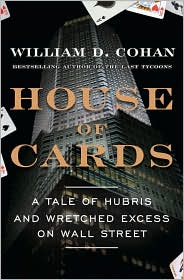


House of Cards by William Cohan is the "inside story" of the demise of Bear Stearns, the venerable investment bank that was the first domino to fall in the credit crisis of 2008. The story is divided into two parts, and the order in which they are presented is curious. The first section of the book is a detailed account of the 10 fateful days in early 2008 that it took for Bear to go from a fully functional, money-minting investment bank to insolvent. This is followed by a history of the firm, from it's earliest days through the departure of its notorious leader, Jimmy Cayne, just months before the end.


I almost didn't make it through the first part. On more than one occasion I put the book down and had to basically force myself to pick it up again. This section was confusing as hell. Too many names were being thrown around and I didn't have a sense of who any of them are. Sections were poorly written. There were sentences I had to read two or three times in order to divine their point. And worst of all, there were two blatant mistakes I discovered within the first 20 pages or so. I understand that when we are dealing with current events, books are rushed into print in order to capitalize on newspaper headlines, but these mistakes are some seriously weak sauce.


Then something strange happened when the book takes a deep breath and jumps back in time 80-odd years: It gets good! Cohan starts building up the personalities of the larger-than-life characters in Bear's long history. And it's so much more interesting to hear about these people's actions when I have some insight into what type of person they are and what roads they travelled to get to their current position.


Once I read through the fascinating history of the firm, I felt like I needed to read the first section of the book again. Now that I knew who Jimmy Cayne, Ace Greenberg and Alan Schwartz were, their actions during the crisis would have held much more meaning. But I just couldn't bring myself to endure the first part again. I didn't want to give Mr. Cohan the satisfaction.


I can understand the reasons for putting the end of the story first. There are certainly other well regarded works of literatureand film that have succeeded using that playbook. But it does not remotely work for House of Cards, unless the reader is a former Bear employee who knows who all these people were already. When Genius Failed, was constructed perfectly. It gave us a tiny taste of the endgame before whisking us back through time to the beginning of the story. Then when it re-reached the turning point it exposed us to in the intro, the unfolding scene made much more sense. I loved being given a glimpse of the dire circumstances in which the firm would end up because it altered my perspective when reading through the heyday of the firm. I wish House of Cards had been written this way.


-----------------------------------------------------------------


And now for something totally unrelated...One of the worst people on all of television has to be Nancy Grace. I can't take any more of her loaded questions and cutting-off of guests. And she acts like a crusader against all the world's injustices and ills, but I think she just loves the spotlight and/or yelling at people from a position of power. Otherwise she would not have written a novel (a vanity project if there ever was one) and would have spent that time investigating the cases that she loves shouting about so much. Or at least she could have written about something related to her work.


I cannot stand overly self-righteous people, and Ms. Grace is a paragon of self-righteousness. She loves oversimplifying things into black and white, rather than into the many shades of gray that are actually present. She loves to pick people apart without ever putting herself out there to be judged by those like herself. I hate this woman.


To me, she is like Joe Morgan, Tim McCarver, Scott Van Pelt and Glenn Beck: She must have a fanbase in order to stay on the air, but the identities of those that count themselves among her fanbase remain a mystery to me.

Thursday, July 30, 2009

Pet Peeve of the Day

...and today's pet peeve is.....

when people say, "all's I know is..."

The some nice winning grammar. That'll get you far. My boss at my college internship used to say this, and he was actually in a position of power. I think saying "all's" should automatically disqualify someone from being promoted. All's I know is I wouldn't be caught dead giving a promotion to someone who can't speak with slightly better grammar than that.

So let's join together and fight against this one. I do not want it to reach the point where it is so widely used that it becomes acceptable. And I'm afraid that we are headed in that direction.

Save the English language!

This Peeve of the day was inspired by Rocco Mediate who just dropped "all's" in an interview with Mike & Mike.

Movie 159: Fanboys

Fanboys (2008) by Kyle Newman
starring Jay Baruchel, Dan Fogler, Chris Marquette and Sam Huntington


In a nutshell: The enthusiasm for Star Wars shines through, but it's too much of a mess

Quick synopsis: In 1998, 4 friends decide to break into George Lucas's Skywalker Ranch in order to steal a copy of Episode 1 before its release

Content: Fanboys was sitting on the shelf for nearly two years before it finally found its way to a few theaters. This is never a good sign. Fanboys actually had some potential; a pretty good cast, a gigantic group of Star Wars fans that might be interested and a presumably small budget. But something went horribly wrong.

Between the four leading guys, I actually liked three of them. And the one I did not like was Jay Baruchel who I have liked a great deal in other things (Undeclared, Knocked Up). Kristen Bell is also around quite a bit. And the one and only Shooter McGavin (Christopher McDonald) makes a few brief appearences. I have yet to encounter a movie that did not benefit significantly from his larger-than-life presence. But the problem is not with the cast, it's with the screenplay, if there even was one. The story plays out more like a series of sketches more than it does a continuous story. Of the various problems they encouonter during their cross country trip, none are even remotely related to each other, and none of them add anything to the characters or the story. Instead, they serve as short diversions to waste time. Not surprisingly, these diversions are also incrediby generic: an accidental trip into a gay bar that ends with them stripping on stage, a night spent with an old Native American man who slips them some peyote, an evening unwittingly spent with call girls, and, of course, a night in prison.

The rest of the movie serves mostly as a means of giving many former Star Wars legends cameo appearances. In this sense, it's kinda like Jay and Silent Bob Strike Back, but not as good. The "story" that gives a few characters motive for wanting to go cross-country is incredibly lame. We are told that one of the 4 guys has cancer and is dying. Then this fact is ignored for the bulk of the film as he runs around with everyone else. I was expecting it to be a ploy of Fogler and Baruchel to reunite the other two characters, who were estranged best friends. But alas, no, he was supposed to actually have cancer. And I think we are supposed to assume that he is dead at the end of the film when the remaining character toast to him, but it's not entirely clear. Studio executives tried to remove the cancer storyline from the film and received backlash from fans demanding that it stay in. So, it was hastily edited back in at the last second, and it shows. They would have better off without it.

A few more bullet points:
  • Baruchel and Bell have one of the least convincing love stories I've ever seen. And they used a horrible cliches to bring them together.
  • The jokes are really not funny
  • Too many of the wacky situations they find themselves in are resolved WAY too easily. They end up in tough spots over-and-over again, only to be released unscathed without decent reasons. This happens about 5 times in Fanboys.
  • The only cameo that I enjoyed was that of a certain former Star Trek captain
  • A pre-famous Seth Rogen plays two roles...neither very well
  • The filmmakers' love for Star Wars did show, unlike the Farrelly Brothers supposed love of the Red Sox in Fever Pitch (see below). Unfortunately, they didn't know how to make a decent film though.
Fanboys suffers from a chronic lack of creativity and originality, and from a sloppy, very poorly tied-together story that feels like it was written in an hour by a sixth grader. Even as a fan of Star Wars, I found the whole thing to be pretty pathetic.

Rolling rankings:
1. Good Will Hunting (#156)
2. In Bruges(#153)
3. The Hangover (#157)
4. Harry Potter and the Half-Blood Prince (#155)
5. I.O.U.S.A. (#150)
6. Burn After Reading (#152)
7. The Da Vinci Code (#151)
8. 21 (#154)
9. Fever Pitch (#158)
10. Fanboys (#159)

key:
masterpiece
excellent
good
mixed bag
more bad than good
garbage